
How often should you clean your mattress? A question that leaves many homeowners puzzled, with random advice ranging from “every month” to “every few years.” Such inconsistent direction often leads to uncertainty and compromises proper mattress care.
Our technicians recommend a professional deep cleaning every 12 months as a dependable baseline. Still, this frequency is subject to household usage. A highly active home with pets or allergy-prone members benefits from more frequent cleaning, while a low-activity household may safely extend the interval.
We discussed a lot with our internal team on various aspects and curated this guide with clear insights into mattress cleaning frequency. By factoring in lifestyle, health sensitivities, and environmental conditions, you can make informed decisions that protect indoor air quality, extend mattress life, and ensure healthier sleep.
Why Knowing Mattress Cleaning Frequency Matters?
Your mattresses are more than just sleep surfaces. They act as silent collectors of dust mites, allergens, along with bacteria, mold spores, and dead skin cells buildup.
Each night, body moisture and contact push these contaminants deeper into fibers, while sweat and humidity accelerate microbial growth.
Over time, this accumulation doesn’t just dull appearance; it compromises indoor air quality and can trigger allergies or respiratory issues.
Understanding the right cleaning frequency helps you schedule professional cleaning sessions at the right time. A consistent mattress cleaning schedule reduces allergen exposure, extends mattress life, and ensures a healthier, more refreshing sleep environment. With clear direction, you can avoid confusion and balance professional deep cleaning with DIY upkeep for continued freshness. Here are different timeframes to consider:
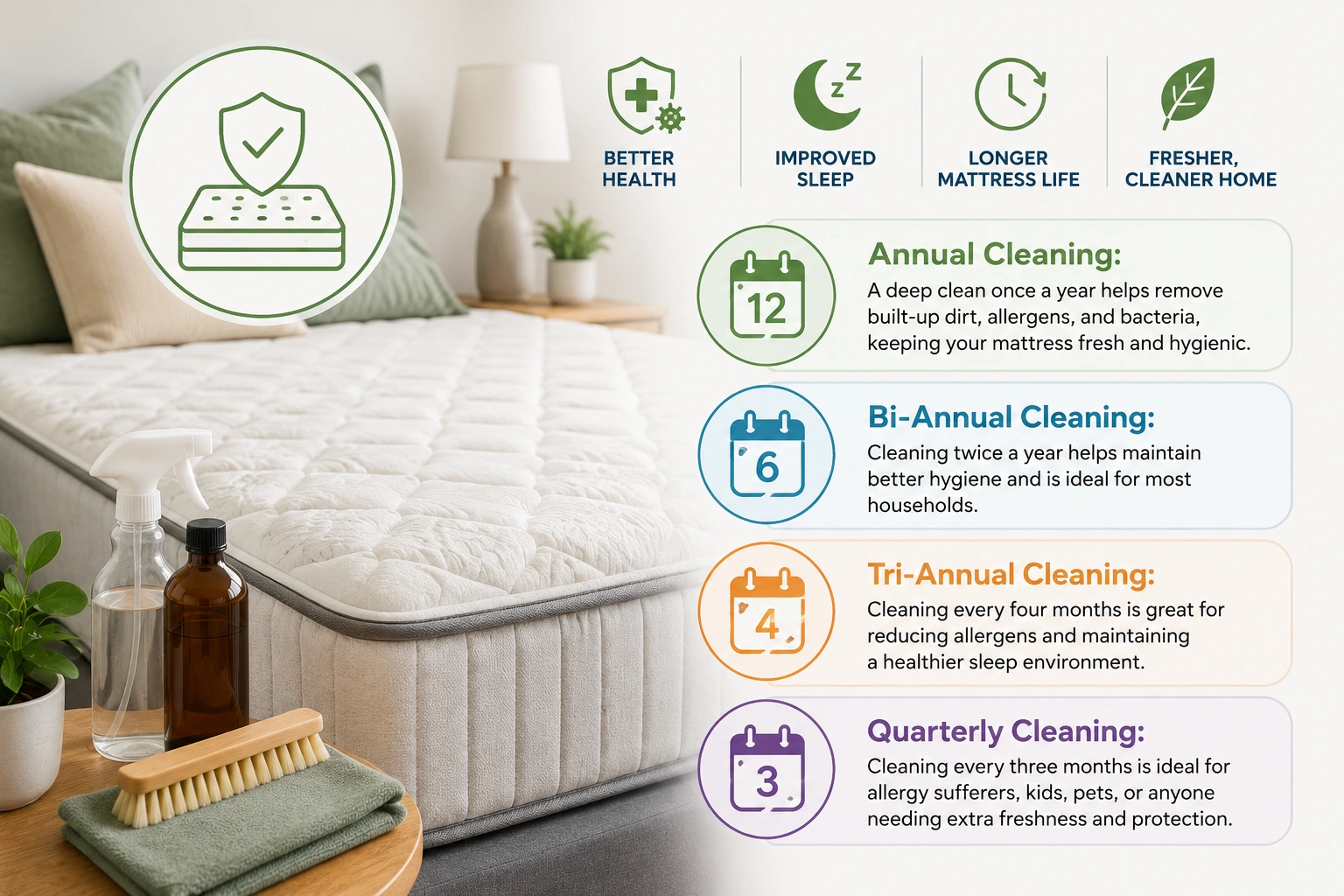
Annual Cleaning: Once every 12 months for low‑traffic households with minimal spills. This schedule works best for mattresses that see light use and benefit from routine DIY upkeep like weekly sheet washing and occasional vacuuming.
Bi‑Annual Cleaning: Every 6 months for average households with regular use. Mattresses in this category accumulate moderate dust and sweat, so pairing bi‑annual deep cleaning with monthly baking soda treatments helps maintain freshness.
Tri‑Annual Cleaning: Every 4 months for allergy‑sensitive families or those with respiratory concerns. Frequent professional cleaning ensures allergens embedded in mattress layers are removed, complementing DIY methods such as vacuuming and dust‑proof covers.
Quarterly Cleaning: Every 3 months for homes with pets, children, or heavy mattress use. This schedule tackles dander, spills, and odors that DIY vacuuming and enzyme spot‑cleaning can’t fully eliminate, keeping the mattress hygienic and long‑lasting.
How Often Should You Clean Your Mattresses: 7 Key Factors to Consider
Mattress cleaning frequency isn’t one‑size‑fits‑all. It depends on daily habits, household conditions, and how the mattress is used. Our experts emphasize that each factor not only influences how often you should clean but also which methods matter most.
From routine DIY steps like vacuuming, baking soda, and weekly bedding washes to scheduled professional deep cleaning for allergens, stains, and long‑term hygiene, every aspect needs to be considered.
Let’s deep dive into the specifics of different factors that affect mattress cleaning frequency and our recommended timeframe:
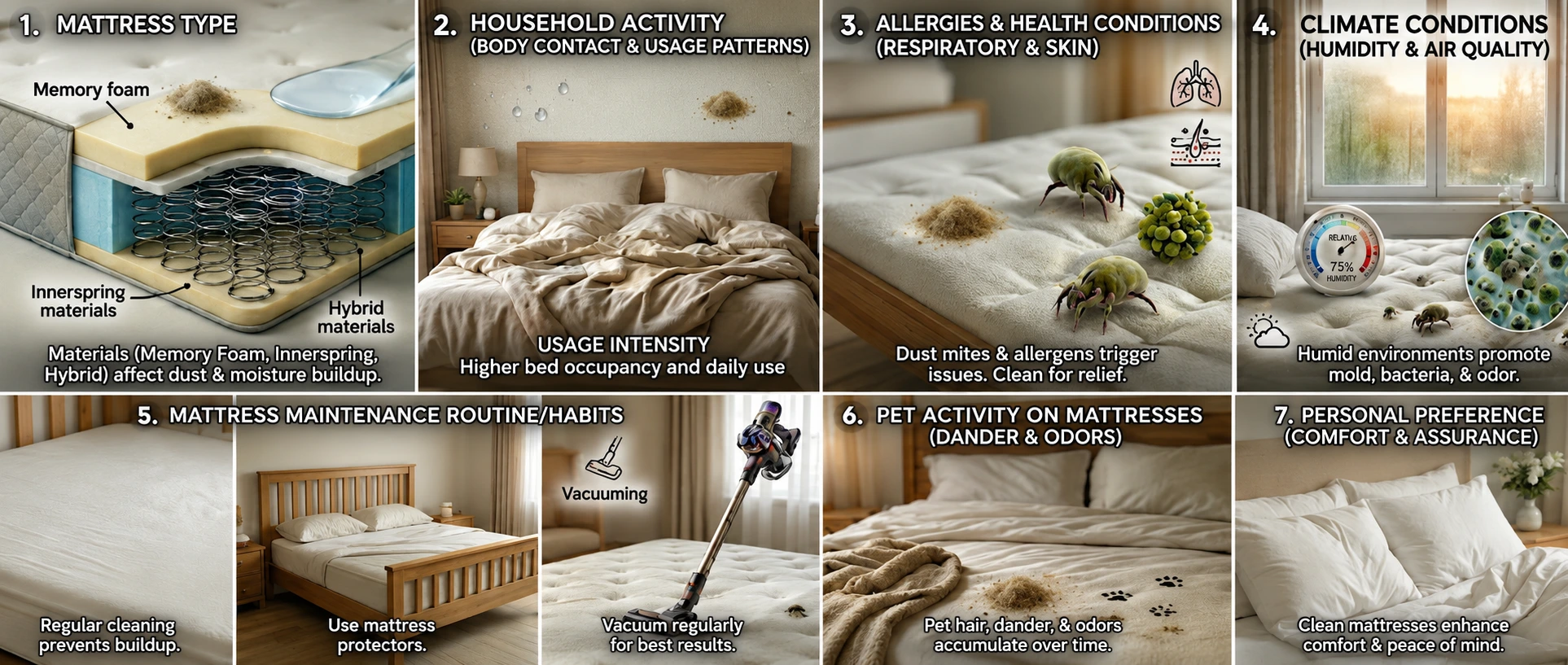
1. Mattress Type (Material & Construction)
A mattress type directly shapes cleaning needs, and schedules should be tailored to material composition and durability. Different materials absorb oils, sweat, and allergens at varying rates, which means both DIY upkeep and professional cleaning must be adjusted to maintain hygiene and extend mattress life.
Our Recommendation for DIY:
- Memory foam & luxury mattresses: Vacuum every 2 to 3 weeks; air mattresses monthly.
- Synthetic or coil‑based mattresses: Vacuum monthly; use baking soda every 3 months.
- Natural fiber mattresses (latex, cotton): Vacuum every 2 to 3 weeks
- Older mattresses: Vacuum every 1 to 2 weeks
Professional Mattress Cleaning Frequency:
- Memory foam & luxury mattresses: Every 6 months (bi‑annual)
- Synthetic or coil‑based mattresses: Every 12 months (annual)
- Natural fiber mattresses: Every 6 months (bi‑annual)
- Older mattresses: Every 3 or 4 months (quarterly or tri‑annual)
2. Household Activity (Body Contact & Usage Patterns)
Your household activity level and lifestyle directly impact mattress cleanliness. Our technicians note that the more people use a mattress daily, the faster sweat, oils, and debris accumulate. Busy households with children or pets naturally require more frequent cleaning compared to low‑activity homes.
Our Recommendation for DIY:
- High activity households (children, pets): Vacuum weekly; spot‑clean as needed
- Average activity households: Vacuum every 2 weeks
- Low activity households: Vacuum monthly
Professional Mattress Cleaning Frequency:
- High activity households: Every 6 months (bi‑annual)
- Average activity households: Every 12 months (annual)
- Low activity households: Every 12 to 18 months (extended annual)
3. Allergies and Health Conditions (Respiratory & Skin)
Dust mites are tiny bugs that are hardly visible. They feed on human skin flakes and are found in mattresses. The U.S. Environmental Protection Agency (EPA) notes that mattresses harboring dust mites and allergens worsen asthma and trigger respiratory issues.
Hence, our mattress cleaning experts insist that allergy‑prone households must have stricter cleaning schedules to minimize exposure and maintain hygiene.
Our Recommendation for DIY:
- Severe allergies/asthma: Vacuum weekly with a quality machine; air mattress weekly
- Moderate allergies: Vacuum every 2 weeks; baking soda monthly
- Mild/no allergies: Vacuum monthly
Professional Mattress Cleaning Frequency:
- Severe allergies: Every 4 months (tri‑annual)
- Moderate allergies: Every 6 months (bi‑annual)
- Mild allergies: Every 12 months (annual)
4. Climate Conditions (Humidity & Air Quality)
Local climate plays a major role in how quickly mattresses attract dust mites, mold, and pollutants. In Elgin, Illinois, humid summers encourage moisture retention and dust mite growth, while cold winters with closed windows increase indoor air pollution and allergen buildup.
Together, these seasonal shifts make it crucial for homeowners to form a plan that addresses both humidity and indoor air quality.
Our Recommendation for DIY:
- Humid climates: Vacuum every 1 to 2 weeks; air mattress weekly
- Temperate climates: Vacuum every 2 to 3 weeks; air monthly
- Dry climates: Vacuum monthly
Professional Mattress Cleaning Frequency:
- Humid/rainy climates: Every 6 months (bi‑annual)
- Polluted/dusty areas: Every 6 months (bi‑annual)
- Temperate regions: Every 12 months (annual)
- Dry regions: Every 12 to 18 months (extended annual)
5. Mattress Maintenance Routine/Habits
How well you maintain your mattress between cleanings directly affects how often professional mattress cleaning services will be needed. In our experts’ opinion, strong DIY habits can extend these intervals, while negligence shortens them.
Our Recommendation for DIY:
- Excellent habits: Monthly vacuuming
- Good habits: Vacuuming and airing, every 1 to 2 weeks
- Minimal habits: Weekly vacuuming
Professional Mattress Cleaning Frequency:
- Excellent habits: Clean every 12 to 18 months (extended annual)
- Good habits: Every 12 months (annual)
- Minimal habits: Every 6 months (bi‑annual)
6. Pet Activity on Mattresses (Dander & Odors)
Pets introduce fur, dander, and odors that quickly penetrate mattress layers. The more time pets spend on the bed, the more aggressive and frequent the cleaning sessions must be.
Our Recommendation for DIY:
- One pet: Vacuum every 3 to 4 days; baking soda monthly.
- Multiple pets: Vacuum weekly; enzyme spray for odor; wash bedding weekly.
- Pets are active only in the living room: Vacuum every 1 to 2 weeks.
Professional Mattress Cleaning Frequency:
- One pet: Every 6 months.
- Multiple pets: Every 3 months.
- Pets are active only near the living room: Every 6 to 12 months.
7. Personal Preference (Comfort & Assurance)
Some homeowners value peace of mind, prefer to uphold hygiene standards, and do not clean just for the mattress’s appearance. From what our technicians share, personal comfort levels often dictate cleaning frequency and other decisions as well.
Our Recommendation for DIY:
- High preference: Vacuum every 1 to 2 weeks; baking soda monthly; wash bedding weekly.
- Moderate preference: Vacuum every 2–3 weeks; baking soda quarterly.
- Minimal concern: Vacuum monthly.
Professional Mattress Cleaning Frequency:
- High priority: Every 3 to 6 months.
- Moderate priority: Every 6 to 12 months.
- Lower priority with good DIY habits: Every 12 to 18 months.
You may find this helpful: How often should pet owners clean carpet?
Signs You Need Professional Mattress Cleaning
Many homeowners delay professional sessions, overlooking signs that mattresses need deeper care. This neglect allows hidden contaminants to build up, compromising hygiene and indoor air quality.
Here are some signs that indicate the need for professional intervention:
- Stains reappear after spot cleaning, showing residue trapped deep in fibers.
- Lingering odors despite baking soda, often from bacteria or mold.
- Surface looks dull, discolored, or worn from sweat and oils.
- Allergy symptoms increase, signaling dust mite buildup.
- Visible mite droppings or spots remain after vacuuming.
- Musty smell in humid climates, indicating mold growth.
- Stains spread or darken, showing seepage into the core.
- Nighttime congestion or irritation suggests poor hygiene.
- Long gap since the last deep cleaning, even if the mattress looks clean.
Once you observe any of these signs, instantly reach out to pros like us. Here’s what to expect from our trained crew:
1. Inspection
Our team begins with a thorough assessment to identify stains, odors, fabric type, and check the overall mattress condition. The idea is to inspect for visible stains or discoloration, and understand the mattress’s condition to pick the safest cleaning method.
2. Vacuuming
We use a powerful vacuuming tool across the entire surface, seams, and sides to lift dust, allergens, and loose debris. This clears the foundation for deeper cleaning.
3. Pre-Treatment
A gentle pre‑treatment is done using eco-friendly solutions to break down body oils, sweat, and embedded soil. This prepares the fibers for effective extraction without causing any material damage.
4. Deep Extraction
Using the hot water extraction technique, we flush out contaminants from deep within mattress layers, removing residues that DIY cleaning can’t reach.
5. Targeted Spot Treatment
Any remaining stains are treated with specialized solutions, reducing discoloration while protecting delicate fibers and making sure that stubborn spots don’t linger.
6. Controlled Drying
Finally, our process is concluded with the use of regulated airflow to promote thorough drying. This prevents moisture buildup, leaving the mattress fresh, hygienic, and ready for use the same night.
Let Experts Handle Your Delicate Mattress And Restore Comfort
How often should you clean your mattresses should not bother you now, especially after knowing how different factors affect scheduling sessions and how you can focus on cleaning them at different intervals or connect with professional mattress cleaners to sketch the best cleaning plan for your mattresses.
At Green-Gen Carpet & Fine Rug Cleaning, our trained and IICRC-certified team has plenty of experience delivering the best mattress cleaning services in Elgin, IL. With the use of eco-friendly, Green Seal-certified cleaning products and advanced steam cleaning technology to eliminate hidden dirt, dust mites, and bacteria, they facilitate deep cleaning without damaging the fabric or reducing comfort.
Give us a call now to rejuvenate your mattresses for superior comfort.
FAQs
Q. How much does professional mattress cleaning cost?
Professional mattress cleaning in Elgin, IL usually costs between $80 to $150 per session, depending on mattress size and service depth. Single mattresses are on the lower end, while queen and king sizes require more time and heavy equipment, elevating costs. Contact us to discuss pricing.
Q. Should you clean memory foam, hybrid, or latex mattresses differently?
Memory foam, hybrid, and latex mattresses should be cleaned differently, since each material reacts uniquely to moisture and cleaning solutions. Professional methods adjust extraction, spot‑treatments, and drying to protect mattress integrity while ensuring hygiene.
Q. What happens if I never clean my mattress?
If you never clean your mattress, our experts firmly believe that dust mites, allergens, and bacteria will accumulate, leading to odors, stains, and poor indoor air quality. Gradually, this buildup will also worsen allergies and shorten your mattress’s lifespan.
Q. How long does a mattress take to dry after professional cleaning?
A professionally cleaned mattress typically dries within 4 to 6 hours, thanks to controlled airflow and advanced tools used to achieve it. In most cases, our technicians believe it’s safe to sleep on the mattress the same night once drying is done; if not, they do share a specific timeframe before you can use it.